Want to be in the loop?
subscribe to
our notification
Business News
CAN THO EYES TRANSFORMATION INTO A MODERN INTERNATIONAL LOGISTICS HUB
Leveraging strategic infrastructure and ambitious investment plans, Can Tho city is positioning itself as a modern international logistics hub serving the Greater Mekong subregion.
The merger of Can Tho city with Soc Trang and Hau Giang provinces has elevated Can Tho’s status to a centrally administered tier-1 megacity, serving as the core urban centre and growth engine of the delta region.
With its extensively expanded economic space, Can Tho now possesses a range of strategic advantages, including an extensive road transport network with both north-south and east-west expressways; an inland waterway transport system; an international airport; a network of ports along the Hau River; a large concentration of industrial parks and agricultural and seafood processing facilities; and connectivity to the Mekong development corridor.
These advantages provide better conditions for Can Tho to develop into the region’s logistics hub, serving as an effective link between production, processing, trade and exports.
The city has identified logistics as a high value-added, knowledge-intensive economic sector that plays a decisive role in enhancing the competitiveness of the delta region’s commodities. Such development is considered one of the city’s strategic priorities, with the goal of transforming Can Tho into the cargo transshipment centre and supply chain coordination centre of the Mekong Delta region.
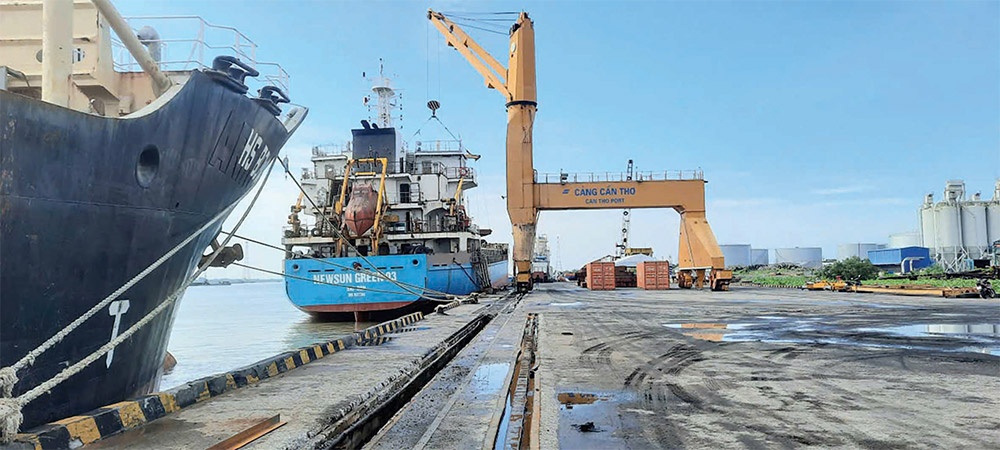
A vessel docks at Cai Cui Port in Can Tho city
Funding for logistics
According to Can Tho Department of Industry and Trade, the city is currently home to more than 500 enterprises involved in logistics-related activities.
In addition, four centres are already in operation: the Hau Giang maritime services and seaport area, Mekong port and logistics centre, Hau Giang agricultural export centre, and Number One Co., Ltd.’s logistics centre, all located in Chau Thanh commune.
Two additional centres are under construction: Mekong distribution warehouse complex in Chau Thanh commune, and Hau Giang cold store centre in Thanh Xuan commune.
The total cargo throughput handled by Can Tho ports reached approximately 12-15 million tonnes per year in 2025. This figure is expected to double once the new centres become operational.
According to Hua Truong Son, deputy director of Can Tho Department of Industry and Trade, the city’s logistics development strategy aims for the sector’s value-added contribution to account for more than 12 per cent of regional GDP.
The strategy also targets an outsourcing rate for logistics services of over 80 per cent; 70 per cent of sector employees receiving professional and technical training, including 30 per cent holding university degrees or higher; at least 80 per cent of logistics service providers adopting digital transformation solutions; and reaching an average annual growth of more than 16 per cent for the city’s logistics services industry.
To achieve these goals, alongside efforts to attract investment in logistics infrastructure, the city plans to establish a network of core centres through investment promotion initiatives.
These projects include a grade-2 centre linked to Cai Cui Port; a centre associated with Can Tho International Airport; a service port at the Thot Not area; centres in Dai Thanh ward, Hoa Luu commune, and Tan Hoa commune; and both Soc Trang and Tran De logistics centres.
According to Bui Ba Nghiem, a senior specialist at the Agency of Foreign Trade under the Ministry of Industry and Trade, research findings indicate that Can Tho city possesses all the necessary conditions to develop into a modern international logistics service centre for the Mekong delta and the Greater Mekong subregion under an international hub model.
“However, to realise this ambition, the city must shift from a logistics development approach focused on standalone infrastructure to one centred on an integrated ecosystem, where infrastructure, data, services, businesses, human resources and coordination mechanisms are developed in a synchronised manner,” Nghiem said.
The research also highlights that Can Tho’s distinctive competitive advantage does not lie in becoming merely a cargo transshipment hub, but rather in its potential to serve as the supply chain coordination centre for the Mekong delta’s agricultural, seafood and trade sectors.
The city, therefore, should prioritise the development of digital, green, and cold chain logistics services linked to the region’s key industries.
In the long term, Nghiem proposed that Can Tho position itself as a smart, green model and a strategic gateway to the Greater Mekong subregion.
“This will provide the foundation for expanding the city’s development trajectory from its current role as a regional logistics hub to that of a modern international service centre, thereby enhancing the competitiveness of the delta region and promoting deeper integration into the global economy,” said Nghiem.
An integrated system
According to Le Cong Ly, Standing Vice Chairman of Can Tho People’s Committee, in the coming period, the city shall continue reviewing and updating logistics planning.
“The guiding principle is to avoid fragmented planning characterised by isolated warehouses and storage facilities. Instead, the city aims to establish an integrated network of centres linked to Cai Cui, Thot Not, Can Tho International Airport, industrial parks, agricultural and seafood production zones, the Tran De area, and the broader marine economic space,” he said.
The city will focus on developing multimodal logistics, ensuring efficient connectivity among expressways, inland waterways, seaports, air transport and, in the future, railways.
Particular attention will be given to carefully assessing the role of Tran De Port, the Hau River shipping channel, Cai Cui Port, Can Tho International Airport, and a network of satellite logistics centres in order to reduce dependence on transshipment services outside the region.
He also noted that Can Tho will prioritise the development of agricultural, seafood, and cold-chain logistics. The city is calling for investment in cold storage systems, inspection and certification centres, irradiation facilities, packaging and traceability services, trading platforms and on-site export services.
“The objective is to ensure that the region’s agricultural and seafood products can be preserved, processed, inspected, packaged and exported efficiently within the Mekong delta itself,” Ly added.
In addition, the city will focus on developing logistics enterprises and attracting strategic investors. Can Tho plans to establish a list of priority projects and introduce mechanisms facilitating access to land, infrastructure, green finance, workforce training and streamlined investment procedures.
On that basis, the city will invite major logistics companies, shipping lines, air cargo carriers, cold storage operators, e-commerce firms, and agricultural export businesses to participate in building the Can Tho ecosystem.
Source: VIR
Related News
MEMBER CORNER / PROMOTIONS
SOME THINGS IN LIFE ARE SIMPLY IRREPLACEABLE.
They all deserve the highest level of protection. With SentrySafe, you’re not just storing valuables - you’re protecting what truly matters. Designed for durability, security, and peace of mind, every detail is built to keep your belongings safe over time. Because true comfort comes from knowing everything important is secured.
INFRASTRUCTURE / CONSTRUCTION / LOGISTIC / PORT
SMART ENERGY INFRASTRUCTURE CRITICAL FOR GREEN GROWTH
Developing smart energy infrastructure will be critical for Việt Nam to achieve its green growth ambitions, as the global energy transition has entered a new phase that requires more flexible, resilient and digitally enabled energy systems. At the Smart Energy Infrastructure Development Forum in Hà Nội, experts said that countries must move beyond simply expanding renewable power generation and focus on building smarter energy systems.
VIETNAM ECONOMY INVESTMENT
CẦN THƠ AIMS TO ADD 300 NEW BUSINESSES ANNUALLY BY 2030
Authorities in Cần Thơ City have set themselves an ambitious target of attracting 300 businesses each year through 2030 as part of broader efforts to strengthen the private sector as a key engine of economic growth. According to Vương Quốc Nam, vice chairman of its People's Committee, the city is implementing a comprehensive package of measures to foster a more dynamic private economy during the 2026 to 2030 period.
PROPERTY / INDUSTRIAL ZONE
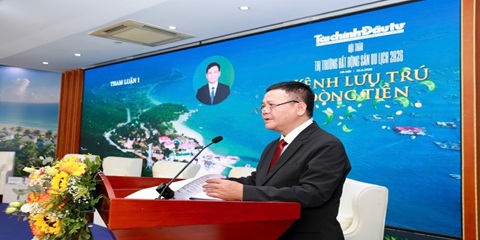
TOURISM AND INFRASTRUCTURE FUEL VIETNAM'S REAL ESTATE GROWTH
According to Chung, 2026 is considered a pivotal year as the Vietnamese economy enters a new development phase with a series of new policies on socioeconomic development, planning, and infrastructure investment. Against the backdrop, the real estate market is facing significant opportunities to enter a new development cycle.

PROPERTY / INDUSTRIAL ZONE
HCMC PROPOSES NO MARKUP ON OFFICIAL LAND PRICES
HCMC’s Department of Natural Resources and Environment has proposed setting the land price adjustment coefficient, known as the K factor, at 1 for households and businesses, meaning land-use fees and rents would be calculated directly from the official land price table without any upward adjustment. The proposal, included in the third draft regulation submitted by the department to the land price appraisal council, is intended to ease financial burdens on residents and businesses while supporting a recovery in the real estate market.
VIETNAM ECONOMY INVESTMENT
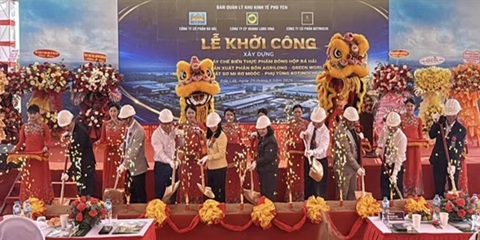
ĐẮK LẮK LAUNCHES THREE MANUFACTURING PROJECTS WORTH US$30 MILLION
Đắk Lắk Province has broken ground on three new industrial projects at Hòa Hiệp 1 Industrial Park with a combined investment of nearly VNĐ790 billion (US$30.2 million). The projects are the Agrilong–Green World Fertiliser Plant, the Bá Hải Canned Food Processing Plant, and the Kotinochi Phú Yên Semi-Trailer and Spare Parts Manufacturing Plant. The investors are Hoang Long Vina JSC, Ba Hai JSC, and Kotinochi JSC, respectively.
Events Sponsors